
Born in 1575 in the hamlet of Fremington, John Penrose became a successful cloth merchant and in 1620 was the Mayor of Barnstaple. On his death in 1624, his Will provided: “(purchase) some convenient room or place within the borough and parish of Barnstaple, fit to erect an almshouse upon, and in the same being so purchased, should, with part of the same money, erect thereupon such and so many several rooms for an almshouse, as they in their discretion should think fit”
In these times it was not unusual for a wealthy person to make a bequest in memory of their name and this handsome bequeath provided for the poor of the borough of Barnstaple and five mile radius.
The provision was used to purchase reclaimed land fronting the main route from Exeter north of the river Taw and a short distance to the east of the old town walls. On completion this building stood alone, with a long symmetrical frontage intended to be viewed from the river and beyond, and bringing to the attention of travellers who passed by, the benevolence of John Penrose.
https://www.barnstaplealmshouses.co.uk/history/
From this bequest, eighteen stone houses were erected in 1627, in a quadrangle predominantly of the style for larger groups of Almshouses from the Elizabethan period onward with a further two being accessed from the front. These houses provide a single room on the ground floor with a room above. Those responsible for building the almshouses exceeded the original bequest to create a frontage to Litchdon Street formed by a grand colonnade with granite pillars, with an inner walkway leading to the Chapel at one end and a meeting room at the other. Accessed by a central passage from the walkway is the inner quadrangle of residences, with a further passage to the rear leading to a large walled garden divided into 20 allotment plots intended for each resident to use for their own self sufficiency.
In his book published in 1952 on North Devon, Nikolaus Pevsner noted; “Ambitious symmetrical front with projecting centre and corners. The receding parts have one-storeyed colonnades of rudely hewn circular granite pillars which are in line with the projecting parts and gabled”. The covered passage behind the colonnades leads to the doors of a Chapel at one end and a meeting room at the other. The houses around the inner quadrangle provide a single ground floor room and a room above; a further but modern day addition is a kitchen and ablution block to the rear. A passage leads on to a large divided and enclosed allotment area at the rear, once intended for residents to use for their self sufficiency.
It was stipulated that the name of John Penrose be carved in granite over the entrance, and his initials, J P carved in the stone and wood to adorn door entrance; but it is probably to his wife, Anne Penrose, that much of the credit is deserved and her initials are carved in small sandstone blocks above each upper window within the inner quadrangle. A tablet recording this benevolence is carved in granite over the entrance, with initials ‘JP’ carved in the wood of the main door entrance.
Later bequests of land and money gave additional support to the almshouses, or directly to the residences in the form of gifts of coal, bread and money administered by the Trustees. Although these gifts are not given today, it is the policy of the Charities to subsidise maintenance costs from investments.
The architectural importance of Penrose Almshouses is recognised by it’s Grade I & II listing but they remain true to their primary role of providing residential accommodation. The almshouses form part of the heritage trail of Barnstaple, and are visited by locals, tourists, school parties and students interested in seeing a group of buildings that, on face value, appear little changed by the march of time.
Those interested in John Penrose may like to visit his grave in Fremington Parish Church as it is a fine tomb with detailed inscription recording some of his life.
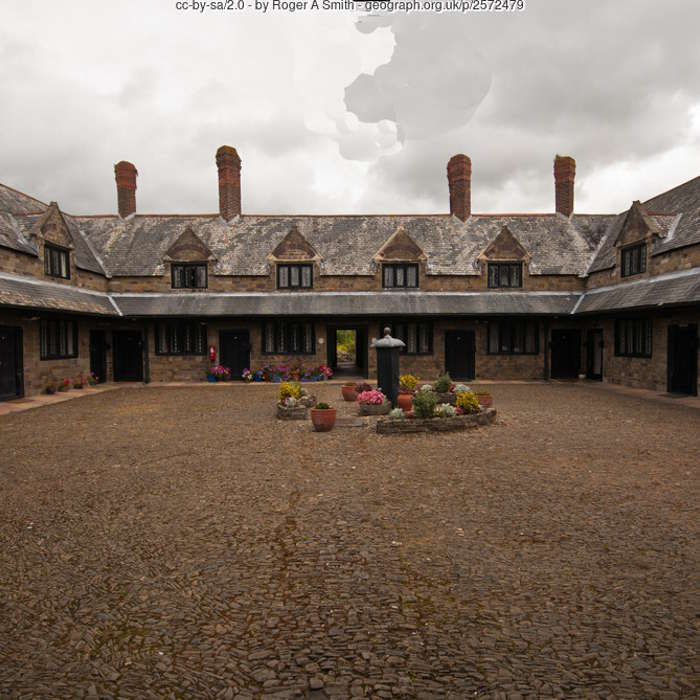
Photo by Roger A. Smith https://www.geograph.org.uk/photo/2572479
Historic England Almshouses, originally 20 dwellings, each for 2 inmates of the same sex. Completed 1627, 3 years after the death of the founder, John Penrose. Later repair and refurbishment includes C20 replanning with partial conversion into flats and some features copying the original. Local ashlar masonry for external walls, internal partitions of brick; granite colonnade; natural slate roofs; brick stacks with old handmade brick shafts with considerable repair in modern brick with corbelled cornices (one original stack retains clustered shafts with a corbelled cornice of moulded bricks; lead gutter on colonnade is brattished and decorated with Tudor roses and oak leaves. PLAN: 4 ranges of almshouses arranged facing onto a large courtyard, with a passageway through from the street and another at the rear, leading to allotments.
https://historicengland.org.uk/listing/the-list/list-entry/1385215
Wikipedia Penrose's Almshouses are 17th-century almshouses in Litchdon Street, Barnstaple, in Devon, England, built in memory of John Penrose (1575–1624), a merchant and Mayor of Barnstaple. They have been a Grade I listed building since 1951.
https://en.wikipedia.org/wiki/Penrose%27s_Almshouses


