Wikipedia Jacqueline Myriam McGlade (born May 30, 1955) is a British-born Canadian marine biologist and environmental informatics professor. Her research concerns the spatial and nonlinear dynamics of ecosystems, climate change and scenario development. She is currently professor of resilience and sustainable development at the University College London Institute for Global Prosperity and Faculty of Engineering, UK, and professor at Strathmore University in the Institute for Public Policy and Governance, Kenya.
She was executive director of the European Environment Agency from 2003 to 2013, where she was on leave from her post as professor of environmental informatics at University College London.
Between 2014 and 2017 she was chief scientist and director of the Science Division of the United Nations Environment Programme based in Nairobi. From 2017 to 2019 she was professor and director of the Sekenani Research Centre of the Maasai Mara University, Kenya.
https://en.wikipedia.org/wiki/Jacqueline_McGlade
Social Media:
Twitter: https://twitter.com/JacquieMcGlade (666)
Researchgate: https://www.researchgate.net/profile/Jacqueline_Mcglade4
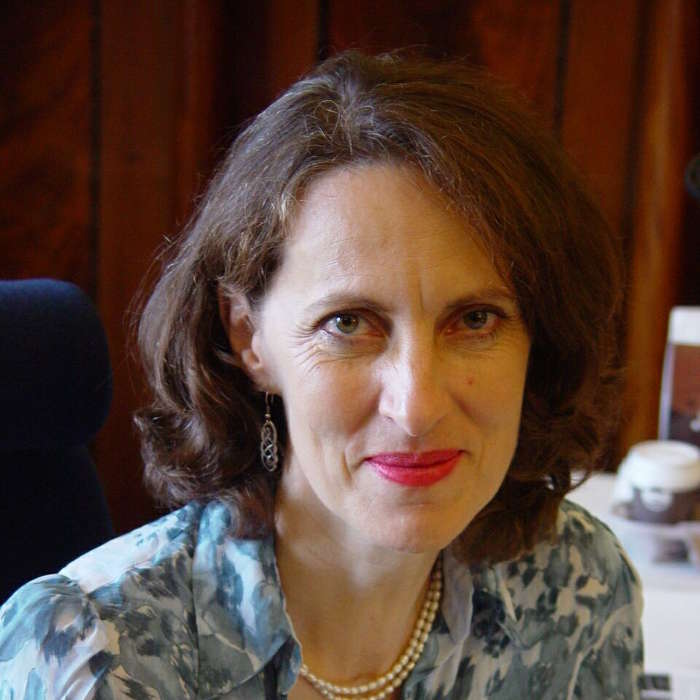
https://commons.wikimedia.org/wiki/File:Jacqueline_McGlade.jpg
EcoBalance - Accounting for the true value of land
The opportunity Whatever your starting-point, if you are interested in healthy food, a strong rural economy, biodiversity or carbon capture and storage, then the answer lies in the land - and in agriculture.
Land needs investment to realise its true potential. And if we invest well, we can produce more food and make it more healthy. We can restore soil, increase biodiversity, make farms more profitable and more resilient to extreme weather. And nature will help us draw down an extra 22 billion tonnes a year of carbon dioxide equivalent from the atmosphere - close to half of total emissions today.
The gap The beauty of nature-based solutions is that we have everything we need at our fingertips. Farmers and other land stewards are ready and willing to adopt new methods of regenerative agriculture that can improve the economic viability and resilience of their land as well as biodiversity and carbon capture. Healthy soils, diverse vegetation, and animal life are not just good for the environment, they are good for everyone.
At the same time, there is no shortage of finance available to help fund this transition. What is missing is a simple and effective way to guide land stewards to the best solutions for their specific land; and to provide financial institutions and investors with the ability to evaluate the plans, provide finance and track progress.
The EcoBalance® app EcoBalance uses big data from satellites and multiple other sources, then applies cutting-edge modelling and knowledge technologies to identify the best land-use options.
EcoBalance connects land stewards, farmers, financial institutions and local and national authorities to manage the challenges around maintaining sustainable agriculture. Land stewards can look at the options available to them and the predicted benefits under different scenarios. Financial institutions can evaluate options, finance them and then track progress. Governments can set targets, inform international negotiations, and encourage optimal land use.
Business Daily Africa - Bioeconomy is central to growth revival post-Covid As the world is grappling on how to adopt the new ways of enhancing economic growth post Covid-19, the answer could be in the bioeconomy. Seen as the oldest business model in the world, bioeconomy is making us change our business model to: “Nothing wasted, everything used and reused, with Nature as the powerhouse”.
Imperial College My research encompasses the knowledge systems that express the dynamics of our planet, its ecosystems, geophysical processes and interactions that human societies have with the natural world to survive and prosper. I am especially interested in climate change, ocean health, food-biodiversity systems and the circular bioeconomy and issues of uncertainty, resilience, complexity and the information dynamics of large networks.
https://www.ucl.ac.uk/bartlett/igp/professor-jacqueline-mcglade
Gresham College For four decades Professor McGlade has worked at the interface of sustainable development, science, society and policy. Her research on biodiversity, climate change, ecosystems, oceans and social dynamics are known the world over. From developing innovative software for virtual gaming and decision-making in areas such as flood management to pioneering open access to data and information she has changed the way we look at and understand the environment. (Includes links to lectures)
https://www.gresham.ac.uk/professors-and-speakers/jacqueline-mcglade/
Institute for Environmental Studies Professor Jacqueline McGlade was appointed Chief Scientist at the United Nations Environment Programme (UNEP) in early 2014. She also holds the post of Professor in Environmental Informatics in the Department of Mathematics at University College London, from which she took leave to take up the position of Executive Director of the European Environment Agency between 2003 and 2013. Prior to this, she was Director of the Centre for Coastal and Marine Sciences of the UK Natural Environment Research Council, Professor of Biological Sciences at the University of Warwick, Director of Theoretical Ecology at the Forschungszentrum Jülich and Senior Scientist at the Bedford Institute of Oceanography in the Federal Government of Canada. Her research is focused on the governance of resources and environmental informatics with particular reference to ecosystems, marine resources and climate change. She has over 200 peer-reviewed papers, articles, books and legal submissions and has produced and presented a number of TV and radio series and programmes plus three feature films. She has been awarded international prizes and honours from Czech Republic, Germany, Italy, Monaco, Romania, Sweden, UK and the USA. Professor McGlade has held a number of key advisory roles and chairs at national level, including Trustee of the Natural History Museum and Board Member of the Environment Agency, at European level, including the European Bank for Reconstruction and Development, and at international levels including for the United Nations and the Consultative Group on International Agriculture Research.
https://www.the-ies.org/about_us/prof-jacqueline-mcglade
European Environment Agency Rather than a one-way communication with the public, Prof. McGlade had a vision for Europe that encourages dialogue with citizens, including indigenous peoples in remote regions such as the Arctic. In 2008, the EEA launched Eye on Earth which brought together environmental data in the form of dynamic maps of air and water quality. Eye on Earth was recognised in the 2012 Rio+20 summit declaration as a key public information platform on the environment. Since then, the Eye on Earth Alliance and Network have grown under Prof. McGlade’s leadership to become a global public information service, bringing together knowledge communities around the world in order to share data and information. The project aims to harness the power of regional networks and governments as well as expertise from researchers, leading thinkers and citizen scientists around the world, to build sustainable solutions for the future.
https://www.eea.europa.eu/highlights/jacqueline-mcglade-leaves-the-eea