
Devon Wildlife Trust The comma is a medium-sized orange-and-brown butterfly. It gets its name from the comma-shaped white spots on the underneath of its wings. It is on the wing throughout the year, having several broods and overwintering as an adult. It is a common and widespread butterfly of woodland edges, particularly during the spring and autumn. The caterpillars feed on common nettles, elms and willows.
They have brown and white flecks that make them look like bird-droppings and help to camouflage them.
How to identify
The comma is unmistakeable: ragged, orange wings with brown spots distinguish it from similar species. Its underside has cryptic brown colouring, making it look like a dead leaf.
https://www.devonwildlifetrust.org/wildlife-explorer/invertebrates/butterflies/comma
Devon Branch of Butterfly Conservation Devon has around 39 resident butterfly species and we can help point you in the right direction on where and when is best to see them. Why not join in our one of our Events (during the summer we organise field events to show you some of our resident butterfly species and in the winter we organise conservation work days to improve the habitat for butterflies in Devon).
https://butterfly-conservation.org/in-your-area/devon-branch
Butterfly Conservation The Comma is a fascinating butterfly. The scalloped edges and cryptic colouring of the wings conceal hibernating adults amongst dead leaves, while the larvae, flecked with brown and white markings, bear close resemblance to bird droppings.
The species has a flexible life cycle, which allows it to capitalize on favourable weather conditions. However, the most remarkable feature of the Comma has been its severe decline in the twentieth century and subsequent comeback. It is now widespread in southern Britain and its range is expanding northwards.
https://butterfly-conservation.org/butterflies/comma
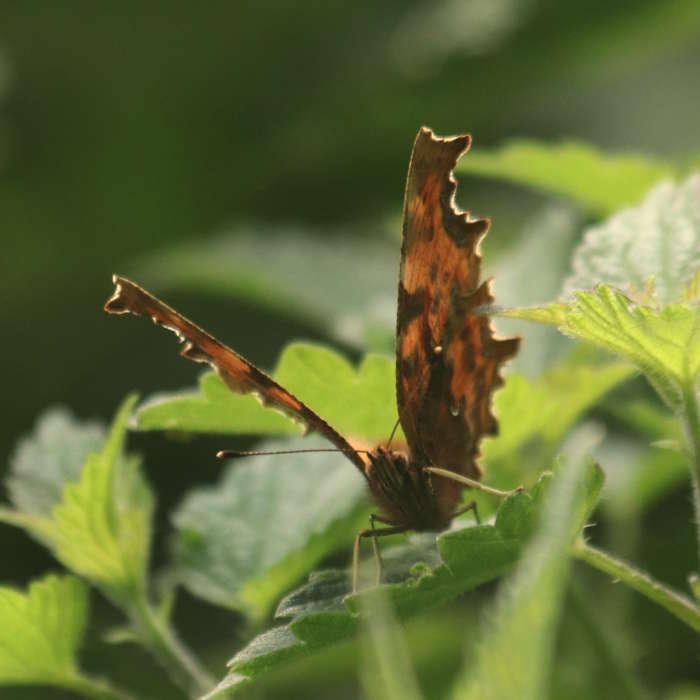
Comma on Nettles, Rock Lane, Chulmleigh, photo by Grant Sherman 20th June 2020
Devonshire Association Entomology Section The Entomology Section promotes the study and recording of insects and also spiders in the county.
Meetings, talks, exhibitions, publications and field trips are arranged annually across the county of Devon and are suitable for beginners and experienced alike. Field trips are usually held in association with other specialist groups with whom we maintain close links. We also meet with other sections to demonstrate, and learn, about the inter-relationships with other disciplines.
With at least ten specialists in different Orders within the insect class we cater for a wide range of interests. Some of our Recorders are national experts in their field and hence we are the major collective source of entomological expertise in the county.
https://devonassoc.org.uk/organisation/sections/entomology-section/
Devon Biodiversity Record Centre Submit your sightings of Commas and other species in Devon
https://www.dbrc.org.uk/wildlife-sightings/
British Naturalist's Association
There are 56 British butterflies species breeding in the UK. These are represented by just six families, skippers (Hesperiidae): swallowtails (Papilionidae): whites and yellows (Pieridae): hairstreaks, coppers and blues (Lycaenidae): metalmarks (Riodinidae) and the fritillaries, nymphalids and browns (Nymphalidae)
Two of these families are represented by only one species, the Papilionidae by the swallowtail (Papilio machaon), which is confined to Norfolk Broads and the Riodinidae by the Duke of Burgundy (Hamearis lucina) found only in local areas in the north-east, north-west and south-east England.
Twenty nine of Great Britain’s breeding butterfly species are listed as ‘High UK priority’, with 9 of those regarded as requiring ‘urgent action across their UK range’. Butterfly Conservation found further evidence of the serious, long-term and ongoing decline of UK butterflies, with 70% of species declining in occurrence since 1976. and overall, 76% of the UK’s resident and regular migrant butterfly species declined in either abundance or occurrence (or both) over the past four decades. By comparison, 47% of species increased in one or both measures. This is of great concern not just for butterflies but for other wildlife species and the overall state of the environment.
https://bna-naturalists.org/id-guide-butterflies/
Buglife is the only organisation in Europe devoted to the conservation of all invertebrates. We’re actively working to save Britain’s rarest little animals, everything from bees to beetles, worms to woodlice and jumping spiders to jellyfish.
National Biodiveristy Network The NBN Atlas is a collaborative project that aggregates biodiversity data from multiple sources and makes it available and usable online. It is the UK’s largest collection of freely available biodiversity data.
https://species.nbnatlas.org/species/NHMSYS0000503893
Wikipedia Polygonia c-album, the comma, is a food generalist (polyphagous) butterfly species belonging to the family Nymphalidae. The angular notches on the edges of the forewings are characteristic of the genus Polygonia, which is why species in the genus are commonly referred to as anglewing butterflies. Comma butterflies can be identified by their prominent orange and dark brown/black dorsal wings.


