
British Naturalists' Association It is associated with a wide variety of waterbodies, Its scientific name means from the Greek helo-, 'marsh', -phil, 'love'. It is the commonest Helophilus species in Britain.
Hoverflies are true flies in the order Diptera. They belong to the family Syrphidae, their most characteristic features is the presence of a longitudinal false vein in the wing. In Britain there are over 270 species recorded and numbers are boosted in some species due to migration to this country. The family is divided into three sub-orders and various tribes, although classifications vary.
The larger species are often brightly coloured and very common. Many any of these have ornate body patterns, often of black and yellow, said to mimic wasps and bees but are harmless. (Birds know not to attack a bee as they will be stung but observations using a tame spotted flycatcher, showed that hoverfly mimicry did not fool it – this bird could distinguish between bees and the black and yellow Syrphinae, readily eating the hoverflies.)
https://bna-naturalists.org/id-guide-hoverflies/
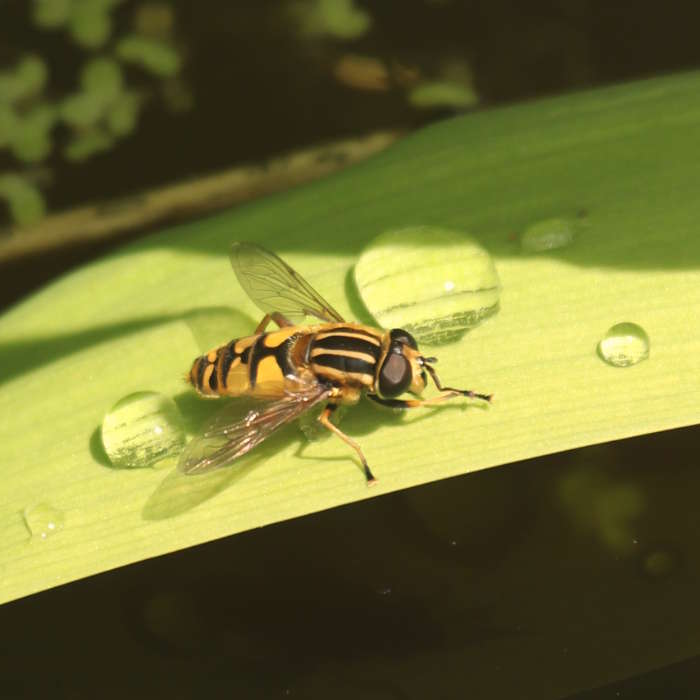
A hoverfly (possibly Helophilus pendulus) in our garden pond, Chulmleigh, photo by Grant Sherman 20th June 2020
Devon Wildlife Trust
https://www.devonwildlifetrust.org/wildlife-explorer/invertebrates/flies
Devonshire Association Entomology Section
https://devonassoc.org.uk/organisation/sections/entomology-section/
Wikipedia Helophilus pendulus is a European hoverfly. Its scientific name means "dangling marsh-lover" (from Greek helo-, "marsh", -phil, "love", Latin pend-, "hang"). It is a very common species in Britain, where it is the commonest Helophilus species. It is found throughout Europe from the Mediterranean to Scandinavia, westward to the Faroe Islands and Iceland, and through eastward through Russia from the Kola Peninsula south to Crimea and across Siberia to the Pacific Ocean.
https://en.wikipedia.org/wiki/Helophilus_pendulus