This is a landscape of contrasts, dominated by its seascape. There are wide westerly views to the sea, with the long, low outline of Lundy visible on the horizon, and views across Bideford Bay as far as Hartland Point. A series of rolling downland ridges run on to long headlands interspersed with sandy beaches. The smooth downland has an elevated, open, character, whilst the rough headlands feel wild, remote and windswept. The beaches are crowded with holidaymakers in summer, but in winter they feel empty and desolate. This is a colourful landscape – green fields; golden sands; vivid purple and yellow heath; brown and grey rocks; and glorious sunsets – but its mood is always set by the ever-changing sea.
This is a fairly small area comprising the westward-facing coast between Saunton Down and Morte Point. To the north is a gradual transition to the North Devon High Coast (where the downland landform is less dominant and there is more woodland) and to the east is another gradual transition to the North Devon Downs. This transition is marked by a gradual reduction in the influence of the sea. To the south is the flat, estuarine landscape of the Taw-Torridge Estuary.
https://www.devon.gov.uk/planning/north-devon-area/north-devon-coastal-downs
https://www.devon.gov.uk/planning/planning-policies/landscape/devon-character-areas
- Hits: 1011
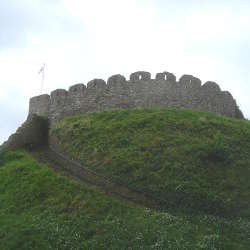
A classic Norman motte and bailey castle, founded soon after the Conquest to overawe the Saxon town. A later stone shell-keep crowns its steep mound, giving sweeping views across the town rooftops to the River Dart.
Climb to the top of the keep to enjoy stunning views over the town of Totnes and across to the River Dart. Or enjoy a picnic in the peaceful grounds under the shelter of age old trees - there is plenty of space for families to relax on a summers day. Within easy walking distance of the town, the castle is an ideal addition to any day out in South Devon and you can combine the visit with one to nearby Dartmouth and Berry Pomeroy Castles which are just a short drive away.
https://www.english-heritage.org.uk/visit/places/totnes-castle/
Totnes Castle Castle Street, Totnes TQ9 5NU
- Hits: 1190

Tucked away in a deep wooded valley, Berry Pomeroy Castle is the perfect romantic ruin with a colourful history of intrigue.
Within the 15th-century defences of the Pomeroy family castle, looms the dramatic ruined shell of its successor, the great Elizabethan mansion of the Seymours. Begun in around 1560 and ambitiously enlarged from around 1600, their mansion was intended to become the most spectacular house in Devon, a match for Longleat and Audley End. Never completed, and abandoned by 1700, it became the focus of blood-curdling ghost stories, recounted in the audio tour.
The location of the castle makes it ideal for walkers who can explore the nearby beautiful woodland or you can enjoy a light lunch, home made cake or restorative cup of tea in the cafe. Within a short drive are Totnes Castle and Dartmouth Castle, making it an ideal day out for families.
https://www.english-heritage.org.uk/visit/places/berry-pomeroy-castle/
Berry Pomeroy Castle Berry Pomeroy, nr Totnes TQ9 6LJ
Social Media:
Facebook: https://www.facebook.com/berrypomeroycastle/
- Hits: 1250
This well-preserved late medieval house, built of local stone, lies near the centre of the Devon town of Paignton. It probably belonged to a well-to-do landowning or merchant family, and had a grand hall with space for up to 20 people to dine together. The house now contains modern furniture, illustrating traditional craftsmanship and the original use of the rooms.
https://www.english-heritage.org.uk/visit/places/kirkham-house-paignton/
Kirkham House Kirkham Street, Paignton TQ3 3AX
- Hits: 974
Some 300 Bronze Age and medieval sites, covering 15.5 square kilometres (6 square miles) of Dartmoor landscape.
Today the Upper Plym Valley is a typically treeless Dartmoor landscape, grazed by cattle, sheep and ponies. It is hard to imagine it 3,500 years ago dotted with settlements of neat round huts, with fields of crops growing near the river and herds of pasturing animals on the higher slopes; or, in medieval and later times, alive with the activity of rabbit farming and tin streaming.
The Upper Plym Valley has an extraordinary concentration of stone remains littered across an area of 15.5 square kilometres (6 square miles), making it one of the richest archaeological landscapes of Dartmoor. The area extends from the source of the River Plym down to the china clay pits at Lee Moor, a distance of some 7 kilometres (4.5 miles).
The remarkable survival of so many sites is due largely to the lack of agricultural or industrial activity on the moor in modern times, which has meant that many of the prehistoric and later monuments have been left undisturbed.
Most of the remains belong either to the Bronze Age (about 2300–700 BC) or the Middle Ages. Some indication of the level of activity that once took place here was provided by an archaeological field survey undertaken between 2001 and 2002, when more than 300 monuments dating chiefly from these two periods were recorded.
https://www.english-heritage.org.uk/visit/places/upper-plym-valley/
Upper Plym Valley Dartmoor PL7 5EJ
- Hits: 1135
Dartmoor is rich in prehistoric remains, and the group of monuments at Merrivale is one of the finest on the moor. Side by side here are the remains of a Bronze Age settlement and a complex of ritual sites, including three stone rows, a stone circle, standing stones and a number of cairns – earth mounds associated with burials. The monuments were probably built over a long period, between about 2500 BC and 1000 BC.
https://www.english-heritage.org.uk/visit/places/merrivale-prehistoric-settlement/
Merrivale Princetown, Yelverton, Devon, PL20 6ST
- Hits: 1079
A dramatic 17th century fortress built to defend the coastline from the Dutch, and keep watch on a recently rebellious town, the Royal Citadel is still in use by the military today.
Due to its nature as an operational military establishment, tours may be suspended or cancelled without prior notice. There are strict regulations for entrance please ensure you read the before you go section for further details.
https://www.english-heritage.org.uk/visit/places/royal-citadel-plymouth/
Royal Citadel The Hoe, Plymouth PL1 2PD
- Hits: 1050
One of the most beautifully located fortresses in England. For over 600 years Dartmouth Castle has guarded the narrow entrance to the Dart Estuary and the busy, vibrant port of Dartmouth. It offers stunning views of the estuary and out to sea and offers a great family day out, whatever the weather.
This fascinating complex of defences was begun in 1388 by John Hawley, privateering Mayor of Dartmouth and the prototype of the flamboyant 'Shipman' in Chaucer's Canterbury Tales. About a century later the townsmen added the imposing and well-preserved 'gun tower', probably the very first fortification in Britain purpose-built to mount 'ship-sinking' heavy cannon. Climb to the top for breathtaking views across the estuary and see how it could be blocked in wartime by a heavy chain.
Unusually incorporating the fine church of St Petrox, the castle saw action during the Civil War, and continued in service right up until the Second World War. Successive up-dating included the Victorian 'Old Battery' with its remounted heavy guns, guardrooms and maze of passages to explore.
https://www.english-heritage.org.uk/visit/places/dartmouth-castle/
Dartmouth Castle Castle Road, Dartmouth, Devon, TQ6 0JN
- Hits: 1078
This Tudor fort, built by the borough of Dartmouth between 1522 and 1536, contained heavy guns to protect the prosperous harbour town from attack. It was the last line of defence against enemy ships that had eluded Dartmouth and Kingswear castles and the iron chain stretched across the Dart estuary between them. Occupying a terrace cut from the rocky river bank, Bayard’s Cove Fort is picturesquely sited at the entrance to Dartmouth harbour.
https://www.english-heritage.org.uk/visit/places/bayards-cove-fort/
Bayard's Cove Fort Bayards Cove, Dartmouth, Devon, TQ6 9AX
- Hits: 1120
Beautifully sited on the fringe of Dartmoor, Lydford boasts three defensive features. Near the centre is a 13th century tower on a mound, built as a prison. It later became notorious for harsh punishments, with one of its inmates calling it 'the most annoious, contagious and detestable place within this realm'. To the south is an earlier Norman earthwork castle and to the north, there are Saxon town defences.
https://www.english-heritage.org.uk/visit/places/lydford-castle-and-saxon-town/
Lydford Castle and Saxon Town Lydford EX20 4BH
- Hits: 1018