
Devon Wildlife Trust: About the size of a collared dove, the cuckoo is a scarce summer visitor to most of the UK, arriving in late March and April. Almost as soon as they have laid their eggs, the adults leave for Africa, with young birds following them in late summer. The cuckoo is a 'brood parasite' - it is famous for laying its eggs in other birds' nests and fooling them into raising its young. Dunnocks, meadow pipits and reed warblers are common victims of this 'cuckolding' behaviour. Chicks and adults eat invertebrates; their preferred food is hairy caterpillars that other birds often won't eat.
How to identify
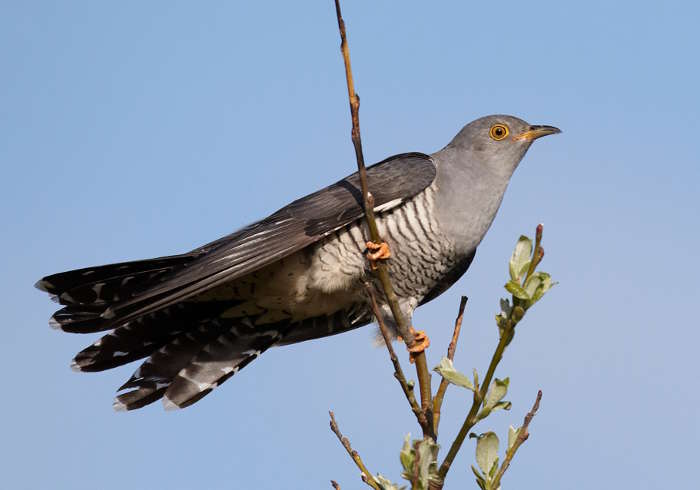
Cuckoos are sometimes mistaken for Sparrowhawks due to their markings: blue-grey backs and heads, with striped, dark grey and white undersides. They have long tails and pointed wings and a hawk-like shape in flight.
RSPB: The cuckoo is a dove-sized bird with blue grey upper parts, head and chest with dark barred white under parts. With their sleek body, long tail and pointed wings they are not unlike kestrels or sparrowhawks. Sexes are similar and the young are brown. They are summer visitors and well-known brood parasites, the females laying their eggs in the nests of other birds, especially meadow pipits, dunnocks and reed warblers. Their recent population decline makes this a Red List species.
https://www.rspb.org.uk/birds-and-wildlife/wildlife-guides/bird-a-z/cuckoo/
Devon Birds: Search the Devon Birds website for recent sightings of Cuckoos in Devon.
Wikipedia: The common cuckoo (Cuculus canorus) is a member of the cuckoo order of birds, Cuculiformes, which includes the roadrunners, the anis and the coucals.
This species is a widespread summer migrant to Europe and Asia, and winters in Africa. It is a brood parasite, which means it lays eggs in the nests of other bird species, particularly of dunnocks, meadow pipits, and reed warblers. Although its eggs are larger than those of its hosts, the eggs in each type of host nest resemble the host's eggs. The adult too is a mimic, in its case of the sparrowhawk; since that species is a predator, the mimicry gives the female time to lay her eggs without being seen to do so.

https://commons.wikimedia.org/wiki/File:CuculusCanorusIUCNver2019_3.png
https://en.wikipedia.org/wiki/Common_cuckoo
Sumer is icumen in
Lhude sing cuccu
Groweth sed
and bloweth med
and springth the wde nu
Sing cuccu
https://en.wikipedia.org/wiki/Sumer_is_icumen_in
eBird: Found in woodland, heathland, farmland with hedges, marshes with scattered bushes. "COO-koo" song (like a cuckoo clock) often given from open perch. Note long wings and tail, barred belly, rather small bill. Flight direct and often low, suggesting a hawk or falcon. Extremely similar in appearance to various other Cuculus cuckoos across its range; note the combination of white vent, staring yellow irises, and overall large size. Lays eggs in nests of other birds, particularly pipits and reed warblers, which raise the young cuckoos.