
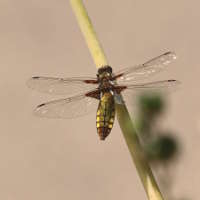
How to identify
The broad, flattened body of the Broad-bodied chaser is distinctive and makes this dragonfly appear 'fat'. The male has a powder-blue body with yellow spots along the sides and a dark thorax; the female is greeny-brown. There are several medium-sized, pale blue dragonflies that can be confused. This species can be distinguished by the combination of its broad, blue body and chocolate-brown eyes.https://www.devonwildlifetrust.org/wildlife-explorer/invertebrates/dragonflies/broad-bodied-chaser
- Hits: 1917

Devon Wildlife Trust A spring delight, the Wood anemone grows in dappled shade in ancient woodlands. Traditional management, such as coppicing, can help such flowers by opening up the woodland floor to sunlight. The Wood anemone is a pretty spring flower of ancient woodlands, and is also planted in graveyards, parks and gardens. Its white flowers bloom between March and May, before the canopy becomes too dense, but its seeds are mostly infertile and it spreads slowly through the growth of its roots.
How to identify
An easily recognisable flower, the Wood anemone is a low-growing plant, with six to seven large, white or purple-streaked 'petals' (which are actually its sepals), surrounding a cluster of distinctive yellow anthers. Its leaves are deeply lobed and it has a thin, red stem.
https://www.devonwildlifetrust.org/wildlife-explorer/wildflowers/wood-anemone
- Hits: 1537

How to identify
The house martin is glossy black above, completely white below, and has a white rump and a short, forked tail.- Hits: 1389

They feast on small flying insects and other airborne arthropods, usually catching them high up in the sky. Insects collect in a special pouch at the back of the swift's throat, where they are bound together by saliva until they form a kind of pellet known as a bolus, which can be regurgitated and fed to chicks. A single bolus can contain over 300 insects, with some holding over 1,000.
How to identify
The swift is black all over, with a small, pale patch on its throat. Looking a bit like a boomerang when in the air, it is very sociable and can often be spotted in groups wheeling over roofs and calling to each other with high-pitched screams. It is larger than swallows and martins (which have white undersides) and, unlike them, does not perch on wires, buildings or trees.https://www.devonwildlifetrust.org/wildlife-explorer/birds/swallows-swift-martins-and-nightjar/swift
- Hits: 1525

How to identify
Our smallest swallow, the sand martin is brown above and white below, with a brown band across its breast and a short, forked tail.- Hits: 1455
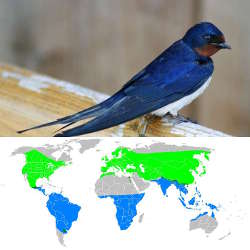
How to identify
The swallow is a glossy, dark blue-black above and white below, with a dark red forehead and throat, and a black band across its chest. It has a very long, forked tail. Often spotted perching on wires in small numbers.- Hits: 1512
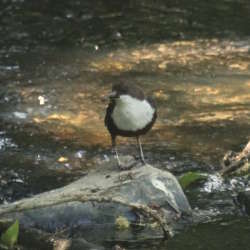
Devon Wildlife Trust A medium-sized, plump bird, the dipper is often seen sitting on a stone in a river or stream, bobbing up and down. It can be found around fast-flowing streams and rivers, mostly in upland areas, but also in South West England. It feeds on underwater invertebrates, such as stonefly and caddis fly larvae, by walking straight into, and completely under, the water to find them.
How to Identify
The dipper is a short-tailed, chocolate-brown bird, with a white throat and chest.
- Hits: 1548
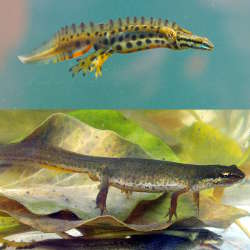
Devon Wildlife Trust You are likely to spot the smooth newt in your garden or local pond. It breeds in water in summer and spends the rest of the year in grassland and woodland, hibernating over winter.
Newts are amphibians, breeding in ponds during the spring and spending most of the rest of the year feeding on invertebrates in woodland, hedgerows, marshes and tussocky grassland. They hibernate underground, among tree roots and in old walls. The smooth newt is also known as the 'Common newt' and is the species you are most likely to find in your garden pond.
How to Identify
The smooth newt is grey-brown, with an orange belly and neat black spots all over. In the breeding season, males have a smooth crest running the full length of their body and tail.
https://www.devonwildlifetrust.org/wildlife-explorer/amphibians/smooth-newt
- Hits: 2044
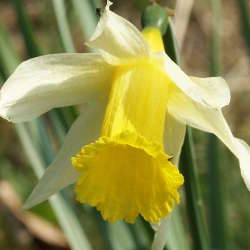
Devon Wildlife Trust The yellow trumpets of daffodils brighten up the dullest spring day as they cluster together in gardens, on roadsides and in parks during March and April. But these are often the planted or escaped garden varieties. A real treat is spotting a Wild daffodil among the dappled shade of an ancient woodland, or pushing up through the grasses of a damp meadow. Once abundant and hand-picked for markets, this wildflower is now much rarer, having declined during the 19th century as a result of habitat loss. It can be seen in parts of south Devon, the Black Mountains in Wales, the Lake District in Cumbria, and along the Gloucestershire-Herefordshire border.
How to identify
The Wild daffodil has narrow, grey-green leaves and a familiar daffodil flower, but with pale yellow petals surrounding a darker yellow trumpet; this two-tone look is one way to tell them apart from their garden relatives. The Wild daffodil is also relatively short and forms clumps, carpeting the ground.
https://www.devonwildlifetrust.org/wildlife-explorer/wildflowers/wild-daffodil
- Hits: 1850

Devon Wildlife Trust A hardy little plant, the Primrose can flower from as early as December in mild years, appearing all the way through the spring until May. It favours woodland clearings, hedgerows and grassland habitats, and sometimes even gardens. Primroses are the food plant of the caterpillars of the rare Duke of Burgundy butterfly, which is a Priority Species under the UK Post-2010 Biodiversity Framework. Since Victorian times, April 19th has been known as 'Primrose Day' in honour of the late Prime Minister Benjamin Disraeli; Primroses, his favourite flowers, are placed at his statue in Westminster Abbey and his grave at Hughenden in Buckinghamshire.
How to identify
Primroses are low-growing plants with rough, tongue-like leaves that grow in a rosette. Their flowers are large and creamy, with deep yellow centres, and often appear clustered together.
https://www.devonwildlifetrust.org/wildlife-explorer/wildflowers/primrose
- Hits: 1552


