

How to identify
- Hits: 1420
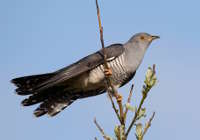
Devon Wildlife Trust: About the size of a collared dove, the cuckoo is a scarce summer visitor to most of the UK, arriving in late March and April. Almost as soon as they have laid their eggs, the adults leave for Africa, with young birds following them in late summer. The cuckoo is a 'brood parasite' - it is famous for laying its eggs in other birds' nests and fooling them into raising its young. Dunnocks, meadow pipits and reed warblers are common victims of this 'cuckolding' behaviour. Chicks and adults eat invertebrates; their preferred food is hairy caterpillars that other birds often won't eat.
How to identify
Cuckoos are sometimes mistaken for Sparrowhawks due to their markings: blue-grey backs and heads, with striped, dark grey and white undersides. They have long tails and pointed wings and a hawk-like shape in flight.
- Hits: 1395
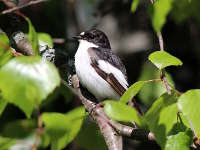
Devon Wildlife Trust The pied flycatcher is a small, black-and-white bird of mature woodland, parks and gardens, with a preference for oak trees.
It is a summer visitor from April and May onwards, and breeds mainly in western areas; it spends the winter in West Africa.
Pied flycatchers may be seen sitting patiently on a perch, waiting for a chance to fly out and catch their insect-prey mid-air. They also search for insects on tree trunks and on the ground.
How to Identify
The pied flycatcher is slightly smaller than a house sparrow. Males are mostly black above and white below, with a bold white patch on the folded wing. Females have the same basic patterning, but are browner in colour.
- Hits: 1418
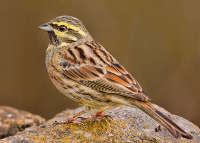
RSPB The cirl bunting is a charming relative of the yellowhammer that is at the limit of its European range in the UK. In spring, males have a striking black chin, eye stripe and crown and yellow stripes on head and yellow underparts. Female and juveniles look similar to yellowhammers, but have bolder head markings and streaked grey/brown rumps. It is a Schedule 1 species.
Cirl buntings are confined to south-west England. They are best looked for in fields and hedges of south Devon, near to the coast.
https://www.rspb.org.uk/birds-and-wildlife/wildlife-guides/bird-a-z/cirl-bunting/
How to watch cirl buntings
Cirl buntings, as well as being rare, can be difficult to see and are very sensitive to disturbance, particularly during the breeding season.
As a result, they've been given special protection by the Wildlife and Countryside Act, which makes it an offence to intentionally, or recklessly disturb them at or near the nest. Below are some suggestions that will enable you to enjoy watching cirl buntings without distressing them.
- Hits: 1551
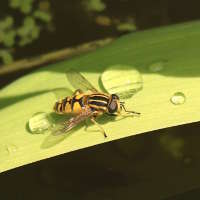
British Naturalists' Association It is associated with a wide variety of waterbodies, Its scientific name means from the Greek helo-, 'marsh', -phil, 'love'. It is the commonest Helophilus species in Britain.
Hoverflies are true flies in the order Diptera. They belong to the family Syrphidae, their most characteristic features is the presence of a longitudinal false vein in the wing. In Britain there are over 270 species recorded and numbers are boosted in some species due to migration to this country. The family is divided into three sub-orders and various tribes, although classifications vary.
The larger species are often brightly coloured and very common. Many any of these have ornate body patterns, often of black and yellow, said to mimic wasps and bees but are harmless. (Birds know not to attack a bee as they will be stung but observations using a tame spotted flycatcher, showed that hoverfly mimicry did not fool it – this bird could distinguish between bees and the black and yellow Syrphinae, readily eating the hoverflies.)
https://bna-naturalists.org/id-guide-hoverflies/
- Hits: 1454
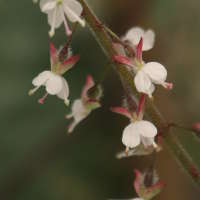
Devon Wildlife Trust Enchanter's nightshade is hairy plant that is actually a member of the willowherb family, rather than being related to deadly nightshade. It can be found in woodlands, hedgerows, gardens and even at the foot of old walls; it especially likes heavy, rich soils. It bears loose clusters of tiny, pinky-white flowers from June to August
and can become a problem 'weed' due to its persistent and creeping habit, spreading by rhizomes (underground stems).
How to identify
Enchanter's nightshade has opposite oval leaves that are rounded at the base, but more pointed at the tip. Its flowers are very light pink and grow in branching clusters (the 'inflorescence') at the ends of the upright stems.
https://www.devonwildlifetrust.org/wildlife-explorer/wildflowers/enchanters-nightshade
- Hits: 1708
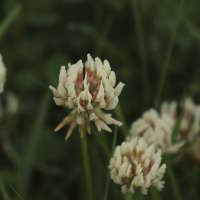
Devon Wildlife Trust White clover is a very common plant of all kinds of grassy areas in the UK, from lawns to pastures, roadsides to meadows, as both a wild and sown flower. The famous trefoil leaves are collected by Wood Mice and are one of the foodplants of the Common Blue butterfly; the flowers appear from May to October and are sought after by all kinds of bumblebees. Looking for a lucky four-leaf clover is a common game among children.
How to identify
Most White clover leaves have the familiar trefoil look with three green leaflets, often bearing white markings. The white (sometime pinkish) flowers are borne in rounded heads.
https://www.devonwildlifetrust.org/wildlife-explorer/wildflowers/white-clover
- Hits: 1402
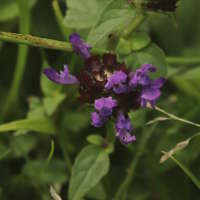
Devon Wildlife Trust Selfheal can be seen creeping through the short turf of a grassland or the uncut grass of a woodland clearing or roadside verge; it can even pop up in lawns that haven't been treated with chemicals. Its clusters of violet flowers appear from June to October and provide a nectar source for bees and wasps.
How to identify
Selfheal is a low-growing, perennial herb with paired, oval leaves and bluish or violet flowers that appear in dense, oblong clusters on the top of its stems. Its purple-tinged seed head remains after flowering.
https://www.devonwildlifetrust.org/wildlife-explorer/wildflowers/selfheal
- Hits: 1391
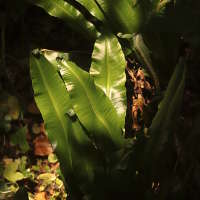
Devon Wildlife Trust The hart's-tongue fern is a medium-sized fern that can be found growing in damp, shady gorges and banks in woodlands, as well as on rocks, walls and mossy branches. It is a hardy plant and is ideal for gardens - plant it in shade under trees, or on walls or gravelly areas for attractive cover all year-round.
How to identify
The hart's-tongue fern is a very simple fern: the frond is a single, glossy, green blade, with orange spores underneath.
https://www.devonwildlifetrust.org/wildlife-explorer/ferns-and-horsetails/harts-tongue-fern
- Hits: 1741

https://en.wikipedia.org/wiki/History_of_Devon#Prehistory https://en.wikipedia.org/wiki/Devon#Human_occupation
- Hits: 1382



