

Devon Wildlife Trust The climbing stems, glossy leaves and round clusters of berries of ivy are a familiar sight across town and country. Growing up trees and old walls, carpeting the ground, and forming thick bushes if left unchecked, this creeping plant is not actually a parasite, as many might think, but only gets support from its host. This host might be a house, shed or a tree in woodland, but none of them will suffer for it. The yellow-green flowers of ivy are a great source of nectar for autumn insects, such as hornets, honeybees and red admiral butterflies. Ivy also provides roosting sites for bats and birds, and a home for hibernating insects.
How to Identify
Ivy is an evergreen and its glossy, oval leaves, with pale veins, can be seen throughout the year. Between September and November, look out for the yellow-green flowers that grow in rounded clusters; these are followed by black berries.
https://www.devonwildlifetrust.org/wildlife-explorer/wildflowers/ivy
- Hits: 1400

Devon Wildlife Trust Holly is one of our most familiar evergreen trees, its bright red berries and glossy leaves bringing colour and life into our gardens and homes in winter, particularly at Christmas (the berries and thorny leaves are said to symbolise Jesus's blood on the crown of thorns). Our wildlife enjoys Holly, too: the berries are an important food source for many birds like Redwings and Fieldfares; indeed, Mistle thrushes guard their own berry-laden bushes with such voracity that they'll chase off any potential thieves. Holly can be found in a variety of habitats, from remote woodland to urban gardens.
How to Identify
Holly is easily recognised by its combination of dark green, spiny, evergreen leaves and small, bright red berries.
https://www.devonwildlifetrust.org/wildlife-explorer/trees-and-shrubs/holly
- Hits: 1402

Devon Wildlife Trust Common frogs are amphibians, breeding in ponds during the spring and spending much of the rest of the year feeding in woodland, gardens, hedgerows and tussocky grassland.
They are familiar inhabitants of garden ponds, where they lay their eggs in big 'rafts' of spawn. They feed on a variety of invertebrates and even smaller amphibians.
How to Identify
The common frog varies in colour enormously, from green to brown and even red or yellow. It has smooth skin, a dark 'mask' behind the eye and long back legs, covered in dark bands. It hops and jumps rather than walks, and lays spawn in large jelly-like clumps.
https://www.devonwildlifetrust.org/wildlife-explorer/amphibians/common-frog
- Hits: 1461

Devon Wildlife Trust The Crab apple is a small tree of woodland edges and hedgerows; it is also frequently planted in commercial orchards. Its pinky-white flowers appear in May and ripen to small, green apples in late summer. This fruit can be used for making jellies and wines or roasted with meat, and, as a result, this tree has been cultivated for thousands of years. Like many of our trees, the Crab apple is important for local wildlife, including Blackbirds, thrushes, mice and voles who all eat the fruit.
How to Identify
The Crab apple can be easily mistaken for other varieties of apple that have been planted or have escaped. It can be distinguished by its small, finely toothed, oval leaves, and small, yellow-green fruits. Orchard varieties tend to have larger fruits and pinker flowers.
https://www.devonwildlifetrust.org/wildlife-explorer/trees-and-shrubs/crab-apple
- Hits: 1681

Devon Wildlife Trust The Common beech is one of our most iconic trees, particularly in the woodlands of the south, such as those found in the Chilterns. Here, it grows tall and broad, turning a shining golden-brown in autumn as its leaves die, and littering the woodland floor with its nuts (known as 'mast'). Beech wood is used for furniture and ornaments; from the 18th century onwards, straight-trunked, uncoppiced trees became a more frequent site in woods and parks - ideal for timber.
How to Identify
The Common beech has shiny, soft, oval leaves; smooth, grey bark; torpedo-shaped buds; and large, hairy fruit that contain the beech nuts.
https://www.devonwildlifetrust.org/wildlife-explorer/trees-and-shrubs/common-beech
- Hits: 1481

Woodland Trust Industrious, delicate, colourful. The spindle is at its loveliest in autumn when its leaves turn russet and its pink and orange fruits ripen. Wildlife loves its leaves and fruit, and aphids flock to it, bringing with them an array of their predators.
Spindle is a deciduous native tree, and mature trees grow to 9m and can live for more than 100 years. The bark and twigs are deep green, becoming darker with age, and have light brown, corky markings. Twigs are thin and straight.
Identified in winter by: the vivid pink fruits which have bright orange seeds. Buds and twigs are angular and green.
- Hits: 1517

Devon Wildlife Trust Beavers are Britain’s largest rodent, belonging to the same group as rats, mice and voles. Thanks to their flat tail and webbed feet these amazing animals are suited to life both on land and in the water. These clever engineers will build dams to give themselves access to deep pools of water and transform their surroundings by cutting down small trees for food and for building supplies. Afterall, no beaver home is complete without their very own private swimming pool. Beavers live with their family, usually around five individuals which includes adults, kits and yearlings. Beavers sleep throughout the day, preferring to come out during sunrise and sunset.
How to Identify
As large as a Labrador dog, but with shorter legs, the European beaver is robust and heavily built. Two distinctive features are a broad, flat tail, covered with scales, and webbed feet. It has small eyes and ears, and light brown fur.
https://www.devonwildlifetrust.org/wildlife-explorer/mammals/beaver
Beavers are very charismatic animals and not that difficult to see if you spend enough time by the river in the right areas. They are nocturnal for much of the year, but during the light summer evenings they can be seen during daylight hours. They are resident in the lower reaches of the River Otter in areas well covered by the public footpath network, and if you spend enough time on these paths during the summer evenings between May and September you stand a good chance of seeing them, as well as otters, kingfishers, dippers, etc.
One of the best areas is currently around Otterton village where the footpaths go north, south and west from the main river bridge, but this can change.
https://www.devonwildlifetrust.org/what-we-do/our-projects/river-otter-beaver-trial
- Hits: 1248

Devon Wildlife Trust The osprey is no stranger to fame and attention - its pursuits have been followed closely by nestcams in the locations where it breeds: Speyside and Perth in Scotland, Kielder, Cumbria and East Midlands in England, and the Dyfi Valley in Wales. A migratory bird, it is present in the UK in summer. Ospreys eat fish, catching them in spectacular fashion as they dive towards lakes and lochs, stretch out their talons and scooping them out of the water with ease.
How to Identify
The osprey is a brown-and-white bird which could possibly be mistaken for a seagull at a distance. The osprey is a large bird of prey with dark brown upperparts and contrasting white underparts that can appear mottled in females. Their heads are white with a dark brown through their eyes. Their wings during flight show strong barring and distinctively dark brown, angled ‘wrists’.
https://www.devonwildlifetrust.org/wildlife-explorer/birds/birds-prey/osprey
- Hits: 1865

Devon Wildlife Trust: These chocolate-brown birds nest in noisy, tightly packed colonies on steep ledges around the coast. They have a very small territory, so small that it only extends a beak’s-length around its nest! Female guillemots lay a single egg a year and once its chick is three weeks old, it will dive off the cliff into the sea with its father. The father will look after the chick in the sea until it is old enough to look after itself. Guillemots eat fish, crabs and molluscs, diving down into the sea and using their wings to swim after their prey.
How to Identify:
The guillemot is chocolate-brown above and white below. A 'bridled' form occurs, where the eye is ringed with white, which extends as a line towards the neck. In winter, guillemots have white faces. The similar-looking razorbill is blacker in colour, and has a thicker and shorter bill.
https://www.devonwildlifetrust.org/wildlife-explorer/birds/seabirds/guillemot
- Hits: 1668
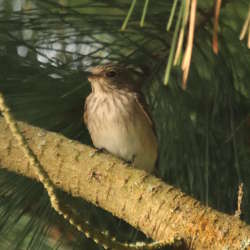
Devon Wildlife Trust The spotted flycatcher is a medium-sized songbird of open woodland, parks and gardens. It has a relatively long tail, which it flicks while it sits patiently on a perch waiting for a chance to fly out and catch its insect-prey mid-air. During the breeding season, spotted flycatchers can be seen across the UK, but they leave here in August for their wintering grounds in tropical Africa. Passage migrants can be seen in September.
How to Identify
A streaky, greyish-brown bird, the spotted flycatcher is pale underneath, with a streaky crown and breast.
- Hits: 1245