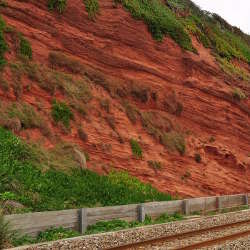
The Devon Redlands National Character Area (NCA) has a very strong, unified character. The underlying red sandstone and consequent red soil dominate the landscape through ploughed fields, cliffs and exposures, and are visually evident in the traditional stone and cob farmsteads, hamlets and villages that are scattered across the area. Not only does the soil visually characterise the area but its fertility also makes it the agricultural heart of Devon. Mixed agriculture has shaped this landscape since medieval times, an era that left a dense pattern of deep and narrow lanes imprinted in the landscape. The gently rolling hills that feature across the NCA support a network of hedgerows enclosing relatively small fields that are either grazed or under arable cultivation. Hedgerow trees and small copses often give a wooded appearance to the hills. The valleys in between are flat bottomed and open into extensive flood plains across the central part of the Redlands. Here, more ‘shrubby’ hedgerows or fences enclose larger arable or grazed fields.
http://publications.naturalengland.org.uk/publication/6150022?category=587130
- Hits: 1426

South Devon National Character Area (NCA) is predominantly a plateau, dissected by steep valleys and rivers, most rising on the adjoining Dartmoor NCA. Towards the coast the often wooded valleys and rias are remote and hard to access from the land. The majority of the area consists of mixed farming, with fields flanked by Devon hedgebanks and narrow winding lanes. The south of the area contains many internationally important coastal and estuarine habitats. These support populations of wintering waders and wildfowl, rare plant communities and also provide significant carbon storage. Much of the area is a popular visitor destination, with the South West Coast Path National Trail being a major asset. Historic market and coastal towns are strategically located across the area and the two major urban settlements are located at either end of the coastal stretch, Plymouth in the west and Torbay in the east.
http://publications.naturalengland.org.uk/publication/1911063?category=587130
- Hits: 1212
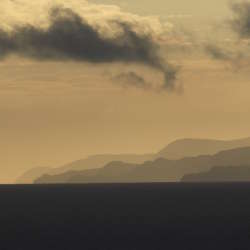
Exmoor National Character Area (NCA) is predominantly a landscape of upland plateaux of Devonian sandstones and slates terminating in the north at the Bristol Channel with a spectacular cliff coastline. It lies across the counties of Devon and Somerset. The Devonian geological time period was first described and recorded in association with this area. To the west the area terminates at Barnstaple/Bideford Bay and the Taw and Torridge Estuary and to the east at the Vale of Taunton Deane. The Exmoor area contains sparse settlement with centres at Braunton, Ilfracombe, Lynton and the western edges of Minehead, all associated with the coast, and inland at Barnstaple, Dunster, Dulverton and Bampton.
http://publications.naturalengland.org.uk/publication/2303045?category=587130
- Hits: 1138
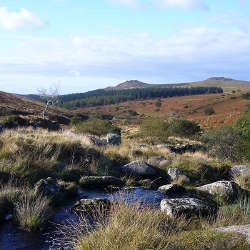
Dartmoor’s extensive upland moorland core rises above the surrounding small-scale, enclosed, predominantly pastoral landscape. Granite unites and characterises the entire National Character Area (NCA). On the moors the distinctive tors create key landscape features, interrupting otherwise unbroken skylines and ridges, and provide focal points for visitors. Isolated farmsteads and scattered villages utilise granite for buildings and walls; and the area’s strong time depth and rich cultural heritage are visually evident because of the granite, which includes the largest concentration of prehistoric stone rows in Britain.
The high moors are overlaid with thick deposits of peat and support internationally important blanket bogs surrounded by large expanses of upland heathland and grass moorland. The bogs and valley mires absorb and store significant amounts of water, as well as carbon, released into the 16 rivers and 8 reservoirs that supply the surrounding urban and rural populations and industry. As rivers leave the high moor they flow through deep-cut valleys steeped in woodland – both semi-natural broadleaved and coniferous plantation. The fast-flowing rivers, strewn with granite boulders, are popular for recreation, both passive and active.
http://publications.naturalengland.org.uk/publication/5098832853467136?category=587130
- Hits: 1042

Established in 1196, Torre Abbey is a museum of history and art housed in an Ancient Scheduled Monument with beautiful and award winning gardens.
Based in Torquay on the stunning English Riviera, this family friendly Torbay Council owned museum and gardens is a centre for creativity and culture - with a seasonal programme of exhibitions, events and activities across visual arts, history and live performance.
Rapidly growing as the Bay’s key cultural hub, Torre Abbey Museum is where world class exhibitions are shown side by side with creative work from local emerging talent.
The Abbey is a real hive of activity which ranges from comedy nights to outdoor theatre and cinema in amongst our stunning ruins. We don’t stop there, the Abbey is also a beautiful setting for weddings, a great space for workshops and the perfect venue for school visits.
https://www.torre-abbey.org.uk/
Torre Abbey Torre, Torquay
Social Media:
Facebook: https://www.facebook.com/torreabbey/ (4.7k)
Twitter: https://twitter.com/TorreAbbey (4k)
Instagram: https://www.instagram.com/torreabbey/ (1.6k)
YouTube: https://www.youtube.com/channel/UCX655y5ZfK9CzpEdhwK3yUg/
- Hits: 1386
Devon Birds entered an agreement with the local landowner in 1996 to build a wheelchair accessible hide on the South side of Beesands Ley (also known as Widdicombe Ley). This provides excellent views across the whole 12ha lake and fringing reeds, scrub and trees.
Location
Beesands lies a couple miles from the main Kingsbridge/Dartmouth road, the A379. From the roundabout in Stokenham follow the signs to Beesands; on reaching the coast, take the first left in front of the houses and park in the area at the end. Take the footpath along the South side of the ley to the bird hide. The path and the bird hide are wheelchair accessible.
https://www.devonbirds.org/birdwatching/places_to_go/beesands_ley
Devon Birds sightings
- Hits: 1115
This area of rough grazing, is small, about 17 acres, and sits at the western end of the Pottington Industrial Estate in Barnstaple. The estate forms the eastern boundary while on the western side is Bradiford Water (a small river). The southern boundary is part of the Tarka Trail. It is a closed reserve, which can be viewed from the five-bar gate at the end of Western Avenue in Pottington, or from the raised ex-railway line that is the Tarka Trail.
https://www.devonbirds.org/birdwatching/places_to_go/bradiford
Devon Birds sightings
- Hits: 1089
The Godborough Castle Reserve is relatively small but well worth a visit if you’re in the North Devon area. (OS 434 273). This reserve was a ‘greenfield site’, established in the late 1990s and it is developing rapidly. The prime aim is to replicate the mixed habitats that would have been found in the area fifty years ago. It has been recognised as a County Wildlife Site.
Devon Birds members and volunteers have planted thousands of trees and berry carrying shrubs to create burgeoning scrub woodland with a spine of relict woodland, including an original Devon Whitebeam. There are pockets of tumble-down grassland that provide feeding grounds for Buzzard and Green Woodpeckers and the full range of grassland butterflies including marbled whites. Peregrine, Kestrel and Sparrowhawk are regular visitors. Relict woodland and hedgebanks support a variety of common bird species, including a full range of warblers. In winter the berry carrying shrubs are a major attraction for fieldfares and redwings. The top of the reserve is the highest point locally and is a good spot to watch for spring and autumn migrants.
https://www.devonbirds.org/birdwatching/places_to_go/godborough_castle
Devon Birds sightings
- Hits: 1369
The Reserve is situated at the eastern end of the esplanade at Budleigh Salterton and comprises the River Otter and adjacent salt marsh areas from the estuary northwards to White Bridge, on the eastern end of the public footpath. The Reserve also includes the reed beds on the western side of the footpath. There are four display boards and a hide either side of the river together with two viewing platforms.
The whole area is managed by the Pebblebed Heaths Conservation Trust on behalf of Clinton Devon Estate. The Trust with the agreement of the tenant farmer have developed and are continuing to develop scrape areas which do not form part of the Reserve but these have added a tremendous diversity to the area.
https://www.devonbirds.org/birdwatching/places_to_go/otter_estuary
Devon Birds sightings
- Hits: 1063
If your think England’s 15th largest city is unlikely to be a good place to go birding, think again! Within the city boundaries you can find an excellent variety of habitat including woodland, estuary, parkland, seafront, lakes and marshlands, offering plenty of choice for birders.
Unfortunately despite the wealth of other birdlife in Plymouth, some - once regular - species are in serious decline, reflecting national trends, eg Purple Sandpiper and Lesser Spotted Woodpecker are all but gone. But for the optimist, keep an eye on the rocky shore at West Hoe for the Sandpipers and Saltram, nearby Hardwick Wood or Plym Bridge Wood for the Woodpeckers.
Finally, don’t be put off looking for birds in Plymouth outside the recognised sites. The potential for “anything turning up anywhere” is illustrated by Hume’s Warbler in the city centre, a Long-eared Owl in a flower pot in Peverell and – rarest of all – a Desert Warbler in a Mount Gould garden!
https://www.devonbirds.org/birdwatching/places_to_go/plymouth
Devon Birds sightings
- Hits: 1149


